
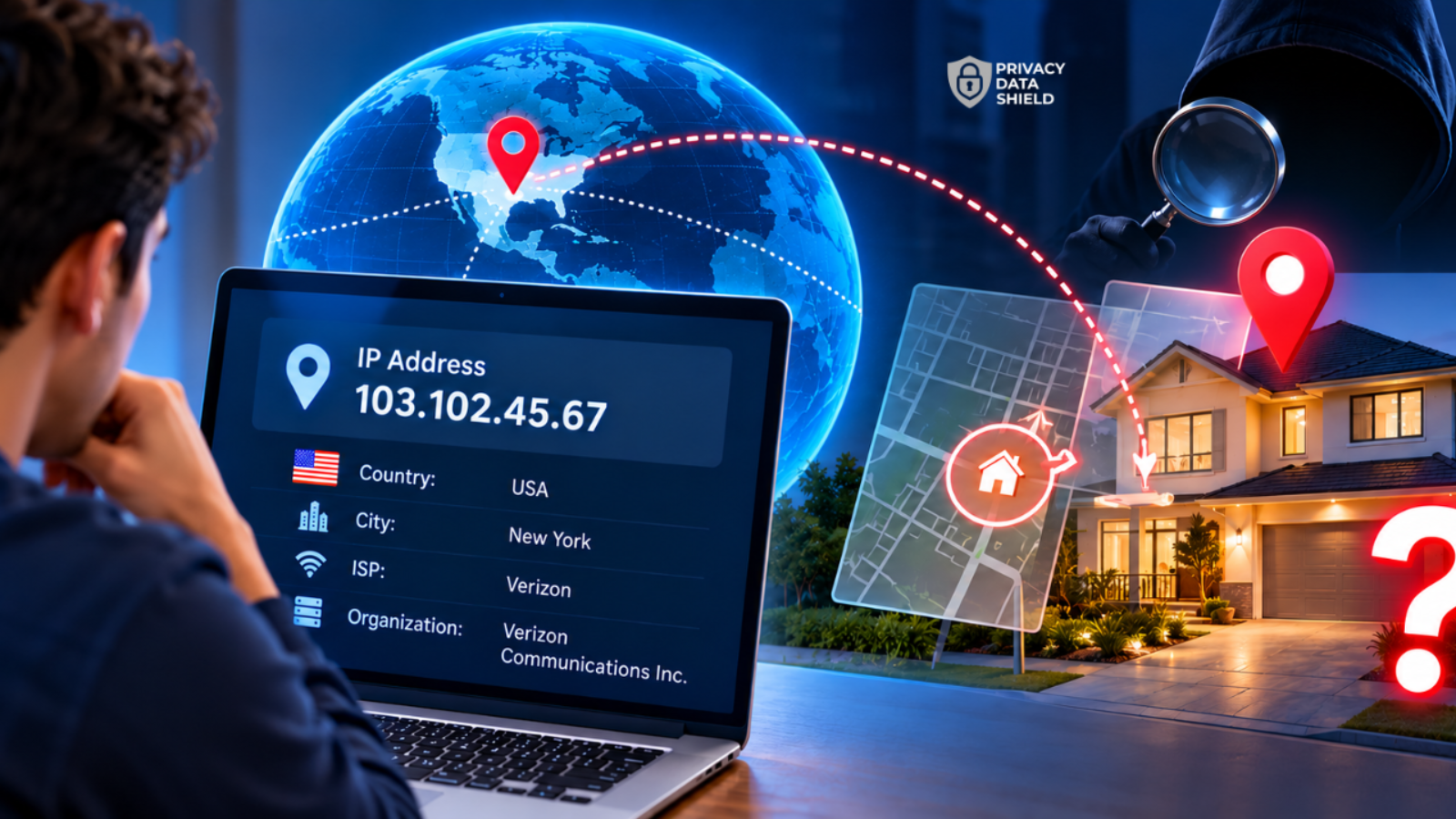
Short answer: not directly. An IP address usually reveals only your approximate location, such as your country, region, or city, plus the name of your internet provider. It doesn’t come with your name or street address attached.
But “usually” isn’t “never.” When other details about you are easy to find online, your IP address can become one more puzzle piece that helps someone narrow down where you live.
Here’s what an IP address does and doesn’t give away, how people really end up with a home address, and what you can do to make yourself much harder to find.
What can someone learn from your IP address?
The quick version looks like this:
| What someone with your IP can usually see | What they usually can’t see | |
|---|---|---|
| Location | Your country, region, and often your city | Your street address or apartment number |
| Provider | Which internet service provider (ISP) you use | Your name or account details, which only your ISP holds |
| Network | The public address your home network uses | Which person or device is behind it |
| Access | That your connection reached their site, game, or server | Your files, passwords, or private messages |
In other words, an IP address works more like a postal sorting code than a street address. It gets mail to the right area, not to the right front door.
What is an IP address, and who knows yours?
An IP (Internet Protocol) address is a string of numbers that identifies your connection on the internet. Your ISP assigns it to your network, which means you don’t actually own it. [1]
Every website, app, game server, and chat service you connect to can normally see it, because they need it to send data back to you. Two more things are worth knowing:
- Everyone at home shares it. Your phone, laptop, and smart TV all go out to the internet through the same public IP address, so activity from any of them appears to come from one place. [1]
- It can change. Many home connections use a dynamic IP address, which your ISP may reassign over time. [2]
How accurate is IP location?
Websites and services estimate your location by matching your IP address against databases of IP ranges. These lookups are useful, but they are estimates.
One geolocation provider puts country-level accuracy at roughly 95% to 99%, but only about 55% to 80% at the state or region level. [2] City-level results are shakier still, for a few reasons:
- Databases lag behind when ISPs reassign addresses; [2]
- Some ISPs use regional or national address blocks, which makes results less precise; [3]
- Mobile networks, shared networks, and VPNs can all throw the result off. [3]
So a lookup will often point to your city, or to your ISP’s local hub, and only rarely to your house.
Who can connect your IP address to your home?
Your ISP can. It knows which customer was using a given IP address at a given time and where that service is installed, and it can share that information with law enforcement. [3]
Random websites, other players in your game lobby, and strangers in a chat room can’t make that connection. That’s why a message like “I have your IP and I know where you live” is usually a bluff meant to scare you.
So how do people actually find home addresses?
Usually not through an IP address at all. The common sources are far more ordinary:
- Data broker and people-search sites that publish names, addresses, and phone numbers;
- Breached databases that leak personal details after a company is hacked;
- Social media posts and photos, including check-ins, tagged locations, and backgrounds that show street signs, landmarks, or packages;
- Public records and online accounts that were never meant to be searched by strangers;
- Compromised accounts and smart home devices that leak details about you or your household.
The FBI warns that attackers often pull sensitive information from many public sources, including online accounts, to build detailed profiles of their targets. It also notes that compromised smart home devices can be used to help carry out “swatting,” the practice of making a hoax emergency report to send armed police to someone’s address. [4] The FBI’s later updates say these hoaxes have also spread to schools, government buildings, hospitals, and other public places. [5]
Where does your IP address fit in? It can give a determined person a starting point, such as your city, which narrows the search once they combine it with a username, a photo, or a leaked record. It’s a clue, not a map.
When does your IP address become a risk?
An IP address alone doesn’t give anyone access to your devices. Still, there are a few situations where having it matters:
- Gaming and streaming. In some games that connect players directly, opponents may be able to see your IP address. Voice chats, screenshots, and stream overlays can leak it too.
- Traffic floods. Someone who has your IP address can try to overwhelm your connection, knocking you offline in the middle of a match, a call, or a live stream.
- Weak spots in your network. An out-of-date router or an exposed camera with a default password is easier to find and probe when someone knows your address.
- Tracking and profiling. Sites and advertisers can use your IP address as one signal for recognizing you and estimating your location.
- Harassment. Even a rough location can be used to intimidate someone, whether or not the person actually knows where you live.
How a VPN helps (and where it doesn’t)
A VPN (Virtual Private Network) puts a layer between your real IP address and the services you connect to. Here’s how it works with a VPN like Privacy Data Shield:
- You turn on the app, which creates an encrypted connection between your device and a VPN server.
- Your traffic travels through that encrypted tunnel, so people on the same network, like a café’s Wi-Fi, can’t read it.
- Websites, games, and chat services see the VPN server’s IP address, not your home IP address.
- Your ISP sees that you’re connected to a VPN, but not the details of what you do inside the tunnel.
The benefits for your home address:
- The location tied to your IP address becomes the server’s location, not your city;
- Other players and chat participants can’t grab your home IP address;
- Your ISP can’t see which sites you visit;
- Your traffic is encrypted on public Wi-Fi.
Here’s what a VPN can’t do, so you’re not left with a false sense of security:
- It doesn’t remove your address from data broker sites or leaked databases;
- It doesn’t stop tracking through cookies, accounts you’re logged into, or browser fingerprinting;
- It doesn’t protect you from phishing, malware, or weak passwords;
- Your VPN provider can see your real IP address, so choose one with a clear, trustworthy privacy policy.
A VPN protects the connection layer. Your information layer, meaning what’s out there about you, needs separate attention.
Keep your real IP address out of sight
Encrypt your connection and hide your home IP address with one tap. Get Privacy Data Shield
How to make your home address harder to find
No single tool does everything, so these steps work best together:
- Use a VPN while you game, stream, or use public Wi-Fi, so your real IP address isn’t exposed to people you don’t know;
- Look yourself up and remove what you find. Search your name, then use the opt-out forms on people-search sites, or use a data removal service;
- Audit your social media. Review old posts, photos, and check-ins for anything that shows your street, your house, or your routine. The FBI specifically recommends reviewing your online presence for sensitive personal information; [4]
- Keep public and private identities separate. Use different usernames and email addresses for gaming, streaming, and forums than you use for banking and deliveries;
- Turn on two-factor authentication and use unique passwords on every account, including smart home devices, as the FBI advises; [4]
- Secure your router. Change the default admin password, install firmware updates, and turn off remote administration if you don’t use it;
- Check whether your email has appeared in a data breach, and change the passwords on any affected account right away;
- Think about where your address is public. For things like domain registrations and business listings, a PO box or a business address can keep your home out of public records.
What to do if someone threatens you with your IP address
Getting a message like that is frightening, but a calm, step-by-step response helps:
- Take a breath. “I have your IP” is not proof that someone knows where you live.
- Don’t engage. Replying often escalates things. Take screenshots instead, and save usernames, links, and timestamps.
- Block and report the person on the platform where it happened.
- Turn on your VPN, and restart your router or ask your ISP about a new IP address. If your address is dynamic, it may change. [2]
- Lock down your accounts. Change passwords and enable two-factor authentication.
- Report it. If you feel threatened, contact your local police. If there’s immediate danger, call your local emergency number. In the US, you can also submit a tip to the FBI at tips.fbi.gov or file a report with the Internet Crime Complaint Center. [4]
So, can someone find your home address from your IP address?
On its own, almost never. An IP address generally points to a city or your ISP, not your front door, and the real link between an IP address and a home sits with your internet provider.
The bigger risk is everything else that’s findable about you: data broker listings, leaked records, social media posts, and exposed smart devices. Hiding your IP address with a VPN removes one clue. Cleaning up what’s out there removes many more. Doing both makes you far harder to target.
Want to take the first step? Get Privacy Data Shield and keep your real IP address private wherever you connect.
FAQ
Can someone find my exact location from my IP address?
No. An IP lookup can usually show your general area, but accuracy varies, and the exact street address isn’t part of the data. [2][3]
Can police find me with my IP address?
Police can ask your ISP, through legal channels, which customer was using an IP address at a given time. That’s how an IP address can lead to a real address, but it requires your ISP, not a stranger. [3]
Can someone hack me with just my IP address?
An IP address by itself isn’t a password or a key. The real risk comes from weak points on your network, like an unpatched router or a camera with a default password, so keep your devices updated and your passwords strong.
Does a VPN hide my IP address from my ISP?
It hides what you do online from your ISP, but your ISP can still see that you’re connected to a VPN server. Meanwhile, your VPN provider can see your real IP address, which is why trust matters when you choose one.
Is a static IP address more dangerous than a dynamic one?
A static IP stays the same, so it’s easier to link your activity to you over time. A dynamic IP changes now and then, which makes long-term tracking a little harder, although it doesn’t replace other privacy steps. [2]
Will changing my IP address stop doxxing?
Not by itself. Doxxing usually relies on information that’s already public, like data broker listings, social media, and leaked records. Changing or hiding your IP address helps, but you also need to reduce what’s findable about you.
